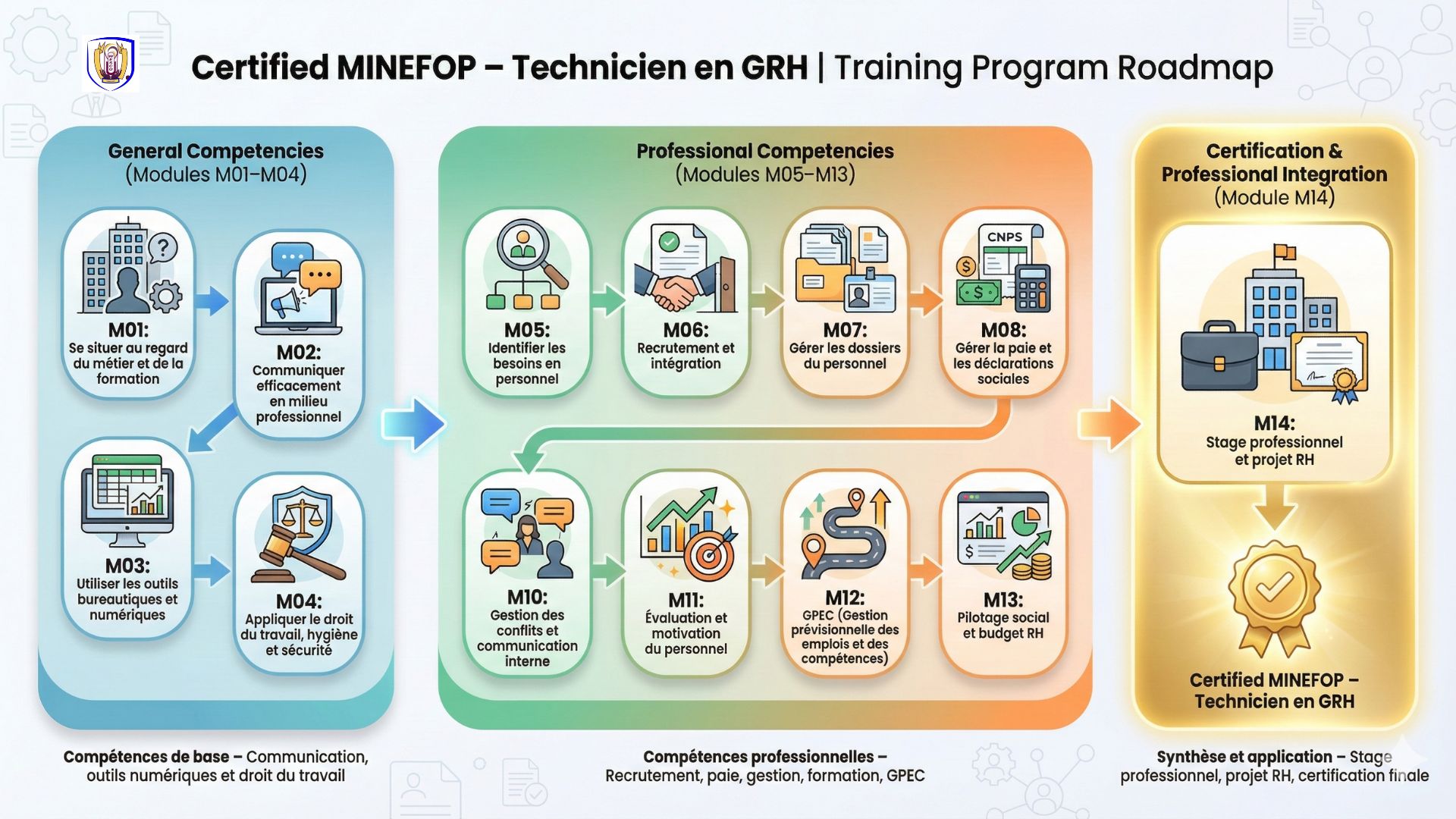
Gestion des Ressources Humaines (GRH)

La Gestion des Ressources Humaines (GRH) est un domaine stratégique qui octroie une valeur ajoutée aux organisations, indépendamment de leur taille ou secteur d’activité. Dans un environnement en constante évolution, caractérisé par des changements rapides au niveau technologique, économique, et social, il est primordial pour les entreprises de s’adapter et de disposer de pratiques RH efficaces. La GRH ne se limite pas uniquement à la gestion administrative du personnel ; elle englobe également des concepts tels que la motivation des employés, l’évaluation des performances, et la gestion des talents.

1

Database Quiz M8L1

Submit quiz
Once you submit, you will no longer be able to change your answers. Are you sure you want to submit the quiz?
1.

In the library analogy provided in the lesson, what do the shelves represent?

Data analysts
Database software
Individual records
Database tables
2.

A database is simply any place where information is kept, such as a physical notebook or scattered files on a personal computer.

True
False
3.

In the library analogy used in the lesson, what does the "Librarian" represent in a database system?

The tables where data is stored
The database software (DBMS)
The individual records
The computer hardware
4.

According to the lesson, which of the following are primary functions of a Database Management System (DBMS)? (Select all that apply)

Create databases and define structures
Analyze data to automatically build dashboards
Insert, retrieve, and update records
Secure information
5.

Data in a database is organized into --A--. Each of these contains --B-- which define the type of data (like Name or Salary), and ---C-- which represent individual records.

A.    B.    C.  

6.

At first glance, a database table might look like an Excel spreadsheet. However, what is the major difference mentioned in the lesson?

Excel uses rows and columns, while databases do not.
Databases are designed to handle millions or billions of records with speed and security.
Databases can only store numbers, while spreadsheets can store text.
Spreadsheets are managed by a DBMS.
7.

Match the components of a library to their direct database equivalents based on the lesson's analogy.

Books
Drag answer here
Shelves
Drag answer here
Librarian
Drag answer here
Records
Tables
Database Software
8.

As a data analyst, you only need to know how to use data in visualization tools; you do not need to understand how the database is structured.

True
False
9.

What does the acronym DBMS stand for?

Data Business Management Server
Database Management System
Digital Blueprint Management Software
Database Maintenance System
10.

Which specific Database Management System (DBMS) will you be installing and using throughout this course?

Oracle
Microsoft Access
MySQL
PostgreSQL
11.

Why is it important that a database provides "structured" storage rather than just regular storage? (Select all that apply)

It makes the database powerful and reliable.
It allows the database to scale as data grows.
It prevents the need for data analysts to use visual dashboards.
It allows for fast and accurate access to information.
  • 1
  • 2
  • 3
  • 4
  • 5
  • 6
  • 7
  • 8
  • 9
  • 10
  • 11
Instructor Sign Up
The password must have a minimum of 8 characters of numbers and letters, contain at least 1 capital letter
Restore password
Password reset link sent to your email
Confirmation link sent Please follow the instructions sent to your email address
Your application is sent We'll send you an email as soon as your application is approved. Go to Profile
Sign up as instructor
Lost Password?
Layer 1
Login Categories